19. Promote your name or loose your fame.

If you believe, as many people do, that the Sydney Opera House is the most famous piece of architecture to be produced in the 20th century, then it follows that the man who designed it, or most of it, Jørn Utzon is one of the most famous architects of that century, nothing less than a genius.
Yet Richard Weston, author of a new book on Utzon, points out that the architect has a relatively low public profile and many architectural historians have neglected his work.
This is perhaps because Utzon, unlike most major architects, has no set predictable style, no school of followers. Nor has he aggressively pushed his views into the public realm as other famous architects have. Not for him the celebrated marathon public lectures of Buckminster Fuller, or the short pithy catchphrases of Frank Lloyd Wright. And indeed for much of his life he has resisted being written about.
The first book to be produced with Utzon’s full co-operation has been written by Professor Weston from Cardiff University’s School of Architecture. And it’s size and considerable weight is the first indication that it’s credentials surveying Utzon’s life and most important work.
Utzon
Author: Richard Weston
Publisher: Edition Blondal 2002
Distributed in Australia by David Messent Photography
Available from Sydney Opera House and the architecture section of good book stores.
From http://www.abc.net.au/rn/czone/stories/s709532.htm. "the comfort zone" with Alan Saunders
ALSO SEE THESE RELATED NOTES FROM PREVIOUS WEEKS:
15. You have to work at it
9. Fight! Its a Hobbesian war.

18. Make it Different
There is one thing that the work of celebrated architects has in common. I am not referring to the fact that their buildings are necessarily more beautiful than those of their less-acclaimed colleagues (in any case, that is not always true), nor that serious architects generally imbue their designs with loftier aspirations than everyday builders. What I am thinking of is something more obvious: that most buildings designed by acclaimed architects, whatever else they are, are different.

What I mean is not merely that they are different one from another, but that they stand apart -- they embody an air of detachment from the world around them. This isolation can be the result of the form of the building. There is nothing else in New York, or indeed in any other city, like the dumpy spiral of the Guggenheim Museum. Sometimes the difference is the result of structural leger demain, like the odd, reverse-stepping facade of the Whitney Museum; or Edward Larrabee Barnes's I.B.M. Building, on Madison Avenue, which looks ordinary enough, until one notices the gravity-defying corner, floating unsupported over the sidewalk. Frequently, famous architects just have the opportunity to do things on a bigger scale than anybody else. Arthur Erickson's Law Courts in Vancouver, B.C., are located under a glass roof, which could be described as a sort of greenhouse, but a greenhouse 350 feet long.
Some buildings startle us with unorthodox materials, such as chain-link fencing, lead-coated copper, or raw plywood, all of which have appeared in Frank Gehry's designs. James Stirling is particularly skillful at the shock effect. No one who has ever seen his Staatsgalerie,

in Stuttgart, Germany, will forget the hot-pink balustrades, as thick as wurst, or the acid-green floor of the entrance hall; the crazy-quilt work of the front of the recently completed Clore Gallery, in London, is equally memorable. Antoine Predock's designs have often used color to effect; the exterior of the United Blood Services building, a blood-donor clinic in Albuquerque, N.M., is startlingly, but appropriately, red, and a pueblolike apartment complex, also in Albuquerque, achieves its major impact from its unusual polychromy.

A striking difference between most works of architecture, and, say, your local K Mart, is that the architecture usually costs a lot more. There is nothing like expensive materials, exacting workmanship, custom-made fittings and elegant appointments to create an atmosphere of exclusiveness. It is the architectural equivalent of the "thunk" you hear when you close the door of a luxury sedan. What sets a luxury car apart from the econobox is also the way it is put together, what automobile devotees call good fit. In buildings, too, there is good fit.
It was Mies van der Rohe who is reputed to have said, "God is in the details." The origin of this statement, like that of his other well-known aphorism -- "Less is more" -- is obscure; no one is sure exactly when he said it. It would be interesting to know the context. Was the famous architect answering a question, and, if so, what was it? For example, had someone asked him about his design for the Illinois Institute of Technology chapel - - the one that resembles a boiler house: "Professor van der Rohe, where is God in this building?" Or had the question to do with his consuming, almost obsessive concern for precision and exactitude in building construction?
Probably the latter, for what characterized all his buildings was the careful and studied way in which they were built. There were no accidents; every corner, every meeting of materials, every point, inside and out, was specially designed to be a part of an esthetic whole. No detail was too small to be pondered. When the British property developer John Palumbo engaged Mies to design an office building on London's Mansion House Square (it was to be his last commission), the first communication he received from the architect, who lived in Chicago, was not a preliminary sketch but a parcel containing brass door handles and travertine ashtrays. "Is this what you had in mind?" queried the accompanying note.
The architectural consequences of such fastidiousness are impressive, but they can also be disconcerting. Whenever I go into a Mies van der Rohe building I am slightly intimidated. I feel like an interloper in another world, one that is flawless, unequivocal and absolute. A perfect world for perfect people.
Mies's influence has waned since his dea th in 1969, but in one sense, at least, all contemporary architects are Miesians, for all share his overriding preoccupation with perfection. Whether they are modernists, post-modernists, or deconstructivists, their buildings exhibit the same desire to bring every facet of the building under their esthetic control, and the same tendency to reject conventional ways of doing things for specially designed ones that carry their personal stamp.
Mies van der Rohe designed his window frames the same way he designed his structures, using standard steel profiles, welded together, which made the windows appear to be an integral part of the building. Le Corbusier, seeking a different effect, often set the window glass directly into a groove in the concrete wall, thus doing away with the window frame altogether, and producing the unexpectedly rustic impression of an opening cut directly into the wall.
The work of Louis Kahn derived much of its impact from a careful articulation of the joints -- the location of every brick was predetermined -- which sometimes makes his buildings look as if they were the work of a cabinetmaker rather than an architect. An interior by Richard Meier achieves its minimalist impression because the designer has ingeniously done away with most of the moldings and joints that occur in ordinary rooms, which enables all the surfaces -- walls, ceilings, soffits -- to blend seamlessly into a sculptural whole. The simplicity is deceptive; in fact, such subterfuge is both difficult and expensive.
It seems to me that this emphasis on the minutiae of construction is something modern. In the past, architects relied on craftsmen and builders to carry out their work, and did not concern themselves with inventing new construction details. Of course, buildings had details, but at any particular time these did not vary a great deal since they followed strict conventions. Ornament, not construction, was the way architects dealt with the joints and junctions.


When the modernists banished ornament from architecture, they were obliged to replace it with something, and construction details became a new type of decoration. In time, this technical adornment became more imaginative, more personal, but also more precious, and fussier. Beauty had been re interpreted as mechanical perfection.
There is some indication that this situation may now be slowly changing. With a renewed interest on the part of some architects in figurative ornament, there is no longer a need to adorn the building with unusual and peculiar details. The recent work of Michael Graves, or Robert A. M. Stern, for example, achieves its chief architectural impact through decoration and the ornamental treatment of surfaces rather than from finicky joints. The forms and colors may be unusual, but the technical bits and pieces, more often than not, are ordinary. The result is that their buildings, while losing nothing in originality, are also more familiar. They may not be perfect, but then neither are we.
From The New York Times; "It Seems That God Isn't in the Details, After All" By Witold Rybczynski
17. Blow your own horn!
The ONE thing that keeps most people from becoming rich and famous - and how YOU can grab that crucial advantage for yourself!
What's the one thing that keeps people from achieving the wealth and fame they probably deserve? It's so simple, yet almost nobody knows how to do it. Without this one thing, you might achieve a little and do okay, but getting rich and famous will be far, far out of your reach. So, what is this one crucial ingredient for the ultimate success? Blow your own horn!

That's right--most people don't know how to blow their own horn. They don't know how to QUICKLY IMPRESS you with how much they know, how helpful they can be, how much they have achieved, how fast they can get new information, AND - most importantly - how they can help YOU get what you want.
Promoting yourself is absolutely crucial to becoming a well-known, trusted figure in your field. And mark my word, once you become "famous" earning a fat paycheck is not far behind. Doors will open. People with healthy bank accounts and wallets fat with credit cards will practically INVENT ways to give you money. All it takes is a deep breath and a little know-how.
So let's start promoting you.
Here's how:
 1. Write down a list of every cool thing you have ever done. Make note of all the fun, interesting, complicated, or action-filled experiences of your life. Try to slant your list toward experiences that could show how you can help somebody else in your field.
For example's sake, let's say your list includes:* Took a lifeguard course--learned CPR and how to keep cool in emergency situations.* Worked your way up to assistant manager at a donut shop where you were in charge of arranging work schedules and ordering new inventory.* Spent a couple of years going to college where you took English composition, physical science, two business management courses, and financial accounting.* Now you read the boss's copy of the Wall Street Journal every day, and spent last Saturday at the library sitting in a comfy chair reading through all the latest popular business books.
Now let's BLOW YOUR HORN. Granted, there are millions of people who have experience very much like yours, but there is no reason we have to make you sound ordinary.
2. Write a paragraph that briefly shows how your life experience qualifies you to be a big help to someone in your field. Let's say you want to consult over-worked managers like your boss. Your paragraph might be:
I learned how to think clearly and act fast in crucial situations while training to be a life guard. Later I mastered managing people and materials while working in management and inventory control for a busy mid-sized business. That experience, in addition to my university training in management, analytical thinking, and concise communication, have given me a sharp mind and a cool head. Now I stay abreast of cutting-edge trends through industry periodicals and books by important thinkers.
Wow! You sound pretty impressive, don't you? A boss in sore need of clear thinking and new ideas (and what manager isn't?) would welcome having a person like you sitting in her office tossing out thoughts and ideas. And it's all because you learned how to blow your own horn.
 3. Now get covered by media. Mass media has mass audiences. It is the instant way to become famous. Start by dong something that gives media a reason to feature you. You can:
* Crate something big and important* Stage an event that is visual, unusual, or downright crazy* Comment publicly on a current controversy* Write an article for trade publications or ezines* Write a short book and publish it yourself, then send copies to local radio, TV, and newspapers.
4. Repeat the process as often as you can. Keep adding your accomplishments to your "Blow Your Horn" paragraph. When you create a new event, tell about it in a press release, including your "Blow Your Horn" paragraph at the bottom. Send the release to local media, trade publications, and businesses you might want to work with.
If you get nothing else from this article, get this: Don't keep your greatness a secret. YOU ARE GOOD AT SEVERAL THINGS. Tell the world!

by Kevin Nunley
http://DrNunley.com
ALSO SEE THESE RELATED NOTES FROM PREVIOUS WEEKS:
1. Throw a brick at someone famous
2. Use stratagies of a publicist to get in the news
6. Amass Symbolic Capital
16. Become your own clients
ALSO SEE THESE RELATED NOTES FROM PREVIOUS WEEKS:
12. You dont need to be Born Rich
14. Do Good Work & Keep Your Soul
15. You have to work at it
When I was in grad school at Texas, I asked Charles Moore to tell me how he got famous, more specifically how he got great commissions. He said these things happened because he developed the teaching track - teaching, writing and lecturing gave him the money, he said, to keep the office going irrespective of how much work it had coming in. That way, if there wasn't enough fee to do that killer rendering, or to work up presentation materials for publication, say, he could infill with his own money. He got bored with being known for a singular type of work, he said, so as people approached him about starting and being associated with other offices, he did. Being in three places at once was kind of a novelty that helped his profile as well.
... [Moore] said being famous was just like any other driven career track - you have to commit to it, you have to think your way through it, you have to make the right connections with clients, the right types of clients, people who control publication, people on the academic side - you have to devote your life to it, which he did. I don't believe it's a random thing - there's an element of randomness to it, but becoming famous doesn't happen at random. Just ask Britney Spears' mother.
Charles W. Moore with the partners of Centerbrook in 1991 after receiving the Gold Medal from the AIA.
Post from Archinet forum "How to become a Famous Architect"
ALSO SEE THESE RELATED NOTES FROM PREVIOUS WEEKS:
2. Use stratagies of a publicist to get in the news
6. Amass Symbolic Capital
14. Do Good Work & Keep Your Soul
14. Do Good Work & Keep Your Soul
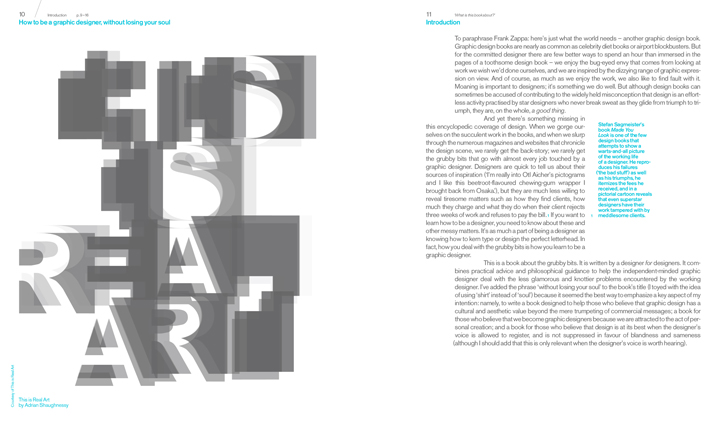
 Adrian Shaughnessy
SU: In your chapter dedicated to self-promotion, you touch on the celebrity issue that has surfaced. I agree that we depend on our reputations to maintain work and get new clients, but things seem to have gotten out of hand. Why have so many designers been lured by celebrity instead of simply making good work?
So, when I talk about celebrity in design, I’m not talking about the sort of celebrity that’s chronicled in the glossy magazines you buy in supermarkets. I think what I’m getting at is that when I became a designer in the mid-seventies, absolutely no thought was given to the notion of fame. Yes, there were famous designers, but they seemed like well-kept secrets; you knew their work, but not much else about them.
Today, every designer knows that they can achieve a certain sort of fame. I don’t even think there’s anything wrong with this – it might even be a useful spur to good work. But if it replaces good work as the ultimate goal of the designer, then I think it is a dangerous cul de sac. I also think that certain designers have become adept at building their own myths. I’m thinking of the way that many graphic designers who came into contact with the music business, learned how to spin their own mythologies. The downside to this is that it creates the illusion of a grime-free existence. If we only read about superstar designers gliding from one lecture theatre to the next, from one perfect job to another, then we have a distorted view of the life of a designer.
It’s one of the reasons why I made Stephan Sagmeister the ‘patron saint’ of my book, I loved the way he exposes (wittily) the myth of design celebrity in his book Made You Look. That was a great inspiration to me.

| If you do good work, you will get noticed. |
| |||
| | ||||

Paradoxically, I think passion is best maintained by having an interest in the world beyond graphic design. One of the reasons why graphic designers have a poor public image is because they are often seen as only being interested in graphic design. The best graphic designers are not obsessed with graphic design to the exclusion of everything else. I also think that the best graphic designers have what I’ve called in the book ‘cultural awareness’. The thing I like best about being a designer is moving from one subject to another. But you can only do this if you have an awareness of what is going on in the world.
But by integrity I mean being honest in the way you deal with the people you inevitably, as a graphic designer, come into contact with. And I also mean believing in something. This can be an aesthetic, a political or a pragmatic belief, but you have to be prepared to stand up for something. If you don’t believe in anything, no one will believe in you.
My main reason for writing this book was my frustration with designers who say – I don’t get any good work. I wanted designers to realize that we can’t go through our working lives blaming clients and the economic climate for our poor work. We have to take responsibility for the successful outcome of a project, and to do this we have to show integrity. It’s a bit glib, but I divide designers into heroes or doormats. And the difference between heroes and doormats is usually integrity.
All images taken from How To Be a Graphic Designer Without Losing Your Soul
 , available by Princeton Architectural Press.
Adrian Shaughnessy is a self-taught graphic designer. Until recently he was creative director of Intro, the London-based design company he co-founded. He left in 2004 to pursue an interest in writing and consultancy, and is currently consultant creative director of This is Real Art, a 'virtual' design company. Shaughnessy has written three books on design for music (the Sampler series) and edited a book of Intro work. He writes for many of the leading design publications, and is a contributor to Design Observer and The Wire. He lectures extensively around the world, and in January 2006 he was appointed editor of a forthcoming magazine devoted to illustration.
13. Take a lesson from Rem Koolhaas
Dear Architects, I Am Sick of Your Shit,
Once, a long time ago in the days of yore, I had a friend who was studying architecture to become, presumably, an architect.
This friend introduced me to other friends, who were also studying architecture. Then these friends had other friends who were architects - real architects doing real architecture like designing luxury condos that look a lot like glass dildos. And these real architects knew other real architects and now the only people I know are architects. And they all design glass dildos that I will never work or live in and serve only to obstruct my view of New Jersey.Do not get me wrong, architects. I like you as a person. I think you are nice, smell good most of the time, and I like your glasses. You have crazy hair, and if you are lucky, most of it is on your head. But I do not care about architecture. It is true. This is what I do care about:
* burritos
* hedgehogs
* coffee
As you can see, architecture is not on the list. I believe that architecture falls somewhere between toenail fungus and invasive colonoscopy in the list of things that interest me.
Perhaps if you didnít talk about it so much, I would be more interested. When you point to a glass cylinder and say proudly, hey my office designed that, I giggle and say it looks like a bong. You turn your head in disgust and shame. You think, obviously she does not understand. What does she know? She is just a writer. She is no architect. She respects vowels, not glass cocks. And then you say now I am designing a lifestyle center, and I ask what is that, and you say it is a place that offers goods and services and retail opportunities and I say you mean like a mall and you say no. It is a lifestyle center. I say it sounds like a mall. I am from the Valley, bitch. I know malls.
Architects, I will not lie, you confuse me. You work sixty, eighty hours a week and yet you are always poor. Why arenít you buying me a drink? Where is your bounty of riches? Maybe you spent it on merlot. Maybe you spent it on hookers and blow. I cannot be sure. It is a mystery. I will leave that to the scientists to figure out.
Architects love to discuss how much sleep they have gotten. One will say how he was at the studio until five in the morning, only to return again two hours later. Then another will say, oh that is nothing. I havenít slept in a week. And then another will say, guess what, I have never slept ever. My dear architects, the measure of how hard youíve worked and how much youíve accomplished is not related to the number of hours you have not slept. Have you heard of Rem Koolhaas? He is a famous architect. I know this because you tell me he is a famous architect. I hear that Rem Koolhaas is always sleeping. He is, I presume, sleeping right now. And I hear he gets shit done. And I also hear that in a stunning move, he is making a building that looks not like a glass cock, but like a concrete vagina. When you sleep more, you get vagina. You can all take a lesson from Rem Koolhaas.
Life is hard for me, please understand. Architects are an important part of my existence. They call me at eleven at night and say they just got off work, am I hungry? Listen, it is practically midnight. I ate hours ago. So long ago that, in fact, I am hungry again. So yes, I will go. Then I will go and there will be other architects talking about AutoCAD shortcuts and something about electric panels and can you believe that is all I did today, what a drag. I look around the table at the poor, tired, and hungry, and think to myself, I have but only one bullet left in the gun. Who will I choose?
I have a friend who is a doctor. He gives me drugs. I enjoy them. I have a friend who is a lawyer. He helped me sue my landlord. My architect friends have given me nothing. No drugs, no medical advice, and they donít know how to spell subpoena. One architect friend figured out that my apartment was one hundred and eighty seven square feet. That was nice. Thanks for that.
I suppose one could ask what someone like me brings to architects like yourselves. I bring cheer. I yell at architects when they start talking about architecture. I force them to discuss far more interesting topics, like turkey eggs. Why do we eat chicken eggs, but not turkey eggs? They are bigger. And people really like turkey. See? I am not afraid to ask the tough questions.
So, dear architects, I will stick around, for only a little while. I hope that one day some of you will become doctors and lawyers or will figure out my taxes. And we will laugh at the days when you spent the entire evening talking about some European youíve never met who designed a building you will never see because you are too busy working on something that will never get built. But even if that day doesnít arrive, give me a call anyway, I am free.
Yours truly,
Annie Choi
from www.partiv.com. originally published in Pidgin, a Princeton School of Architecture Publication under the title “Dear Architects, I am sick of your shit.” Annie Choi is an independent writer, you can visit her website at www.annietown.com.
12. You dont need to be Born Rich
 HE IS the man behind the new design for Wembley Stadium - which controversially scraps its famous twin towers.
But whatever your opinion of Sir Norman Foster and his futuristic visions, no one can deny that he has become the style guru of modern architecture.
Clients around the globe are queuing up for a Foster "signature" building with its trademark sleek, smooth lines.
Today Sir Norman, 64, employs almost 500 people, has offices in London, Tokyo and Hong Kong and a business that enjoys a pounds 20 million turnover. He even owns his own fleet of aircraft.
That's not bad for a working-class lad from Manchester who left school at 16 and drove an ice-cream van to get himself through university.
What makes Sir Norman's story all the more remarkable is that he is the only British architect of note who comes from such a modest background.

An only child, he left school for the traditionally safe white-collar job in the local town hall - but he wanted so much more. As a boy, he had read books about the designer Frank Lloyd Wright in the public library and was gripped. But the odds were against him.
"The idea that anyone in the neighbourhood where I grew up would go to university was like saying: `I'll be the next Pope'," he recalls.
"I wasn't able to get a grant to go to university so I paid my own way. I sold furniture, worked in a bakery, a cold store and drove an ice-cream van."
He also applied for every scholarship and drawing competition he could. In 1959, his hard work paid off and he won pounds 100 and a silver medal from the Royal Institute Of British Architects for a measured drawing of a windmill.
SIR Norman says: "I took off to Scandinavia to look at the new architecture and I haven't stopped travelling since."
His current portfolio includes a transformation of the British Museum, building the first new bridge over the Thames for a century and, of course, the hottest job in the industry - the design of the new Wembley Stadium, which he unveiled on Thursday.
His previous projects have moved from being architectural talking pieces to household names. The Reichstag Building. The Hong Kong And Shanghai Bank. Stansted Airport.
He has also designed the huge new Canary Wharf Jubilee Line station and HSBC tower, a proposed assembly building for the new Lord Mayor Of London and a plan for a Millennium Tower in the City. The London headquarters of his firm Foster & Partners, in Battersea, is a modern riverside palazzo overlooking the Thames. Rows of architects toil on long tables in a room like a railway terminus. At the helm sits Foster himself, notorious for his high standards and drive.
One visitor described it as a cross between a Manchester cotton mill and the headquarters of IBM.
Poised and perma-tanned, Sir Norman - a quiet man whom some regard as cool and detached - looks more like a pop star than an architect. And he has the accessories to match.

A keen flier, he jets around Europe in a white Cessna Citation - one of
 several planes he owns.
He is a regular on the well-heeled party circuit and in 1990 was embraced by the Establishment when he received a knighthood for his services to architecture.
His private life has ensured him constant media attention. His first wife, architect Wendy Cheesman died of cancer in 1989, leaving him devastated. After a brief liaison with Anna Ford, he married Sabiha Malik, the flamboyant ex-wife of Andrew Knight, chairman of News International.
His current wife Elena Ochoa, whom he married three years ago after meeting at the University of Barcelona, is a psychopathologist known in her native Spain for presenting the hit show Hablamos De Sexo (Let's Talk About Sex). The pair have been seen together on the pages of Hola! magazine, that bastion of celebrity life.

But the publicity surrounding Sir Norman's professional endeavours has not always been flattering. Many of his most daring designs such as the Millennium Tower have been ridiculed.
BUT his commitment to his work has never been in doubt. Many say it borders on the manic. "I don't know how to stop," he agrees. "Like a child's toy, I keep spinning. If I stopped, I'd fall over.
"I took my son to Scandinavia and we went sledging with teams of huskies. At first I thought the dogs were being overworked, but I quickly learnt that they are never happier than when pelting flat out.
"I'm not very different."
When the architectural historian Charles Jencks asked him whether his working-class background had been a disadvantage he replied: "Not in the least."
"It gave me a single-minded vision as I sat in the public library as a boy reading about Frank Lloyd Wright.
"None of those middle class kids knew what they wanted from life."
Further Reading:
Lord Foster: Stormin' Norman
Norman Foster - Architect
See Also: Note #7. If you've got "it" use it!
11. Understand The Laws of Epidemics
 in here because we thought it was a very practical guide to becoming famous. The following is an excerpt of wikisummaries' synopsis of the book. As you read it think of it in the context of architectural fame.
Gladwell asserts that most trends, styles, and phenomena are born and spread according to routes of transmission and conveyance that are strikingly similar. In most of these scenarios, whether the event in question is the spread of syphilis in Baltimore’s mean streets or the sudden spike in the popularity of Hush Puppies sales, there is a crucial juncture, which Gladwell terms the “tipping point,” that signals a key moment of crystallization that unifies isolated events into a significant trend. What factors decide whether a particular trend or pattern will take hold? Gladwell introduces three variables that determine whether and when the tipping point will be achieved.
The three “rules of epidemics” that Gladwell identifies are:
the Law of the Few,
the Stickiness Factor,
and the Power of Context.
the Law of the Few
noting that the origins of most major epidemics of sexually transmitted diseases can be traced back to the disproportionate influence of a few “super infectors” who are personally responsible for dozens, or in some cases, hundreds of transmissions. This role is analogous to the category of people that Gladwell identifies as “Connectors,” who play an inordinate ro
 le in helping new trends begin to “tip,” or spread rapidly.
The attainment of the tipping point that transforms a phenomenon into an influential trend usually requires the intervention of a number of influential types of people. In the disease epidemic model Gladwell introduced in Chapter 1, he demonstrated that many outbreaks could be traced back to a small group of infectors. Likewise, on the path toward the tipping point, many trends are ushered into popularity by small groups of individuals that can be classified as Connectors, Mavens, and Salesmen.
Connectors are individuals who have ties in many different realms and act as conduits between them, helping to engender connections, relationships, and “cross-fertilization” that otherwise might not have ever occurred.
Mavens are people who have a strong compulsion to help other consumers by helping them make informed decisions. Salesmen are people whose unusual charisma allows them to be extremely persuasive in inducing others’ buying decisions and behaviors. Gladwell identifies a number of examples of past trends and events that hinged on the influence and involvement of Connectors, Mavens, and Salesmen at key moments in their development.
The Stickiness Factor:
Another crucial factor that plays a key role in determining whether a trend will attain exponential popularity is what Gladwell terms “the stickiness factor.” This refers to a unique quality that compels the phenomenon to “stick” in the minds of the public and influence their future behavior.

An interesting element of stickiness, as defined by Gladwell, is the fact that it is often counterintuitive, or contradictory to the prevailing conventional wisdom. To illustrate this point, Gladwell undertakes an in-depth discussion of the evolution of children’s television between the 1960s and the 2000s.
The PBS show Sesame Street represented a vast improvement in the “stickiness” of children’s television, in large part because it turned many of the long-established assumptions about children’s cognitive abilities and television-watching behaviors on their heads. These changes, based in large part on extensive research, resulted in a show that actually helped toddlers and preschoolers develop literacy.
Years later, the television show Blue’s Clues applied many of these same techniques to Sesame Street itself, resulting in the development of a program that research has shown can generate significant improvements in children’s logic and reasoning abilities. The attribute of stickiness, Gladwell argues, often represents a dramatic divergence from the conventional wisdom of the era.
The Power of Context

Clearly, in order for a trend to tip into massive popularity, large numbers of people need to embrace it. However, Gladwell points out that groups of certain sizes and certain types can often be uniquely conducive to achieving the tipping point. He traces the path of the novel The Divine Secrets of the Ya-Ya Sisterhood from regional cult favorite to national best-seller. Gladwell notes that the unique content of the novel appealed strongly to reading groups of middle-aged women in Northern California, and that these women were uniquely well-positioned to catapult the book to national success as a result of an informal campaign of recommendations and advocacy.
Gladwell also remarks upon the unusual properties tied to the size of social groups. Groups of less than 150 members usually display a level of intimacy, interdependency, and efficiency that begins to dissipate markedly as soon as the group’s size increases over 150. This concept has been exploited by a number of corporations that use it as the foundation of their organizational structures and marketing campaigns.
an edited summary from wikisummaries.org
10. Pay attention to your glasses
 February 9, 2003
Let Me Guess, You Must Be an Architect
By RUTH LA FERLA
He has not had a run on them yet, but Robert Marc, a New York eyewear designer and retailer, would not be surprised to hear customers pleading, "Make me a pair of glasses just like Daniel Libeskind wears."
Mr. Libeskind, the Berlin architect, became the focus of attention last week when it was announced that his firm, Studio Daniel Libeskind, was one of two design teams with a project under consideration for the World Trade Center site. The other was the Think team, headed by the architects Frederic Schwartz, Rafael Viñoly and Ken Smith of New York and Shigeru Ban of Tokyo.
the architects' eyewear. Mr. Viñoly appeared in photographs wearing two pairs of spectacles on his head — something of a fashion signature. Mr. Smith wore his trademark darkWith their soaring towers and memorials, both concepts were the talk of the town. A few New Yorkers, however, seemed almost as impressed by spherical frames, and Mr. Libeskind had on a pair of heavy rectangular spectacles that highlighted his stern expression.
"Libeskind's glasses are out of control," said Brian Sawyer, a New York architect, his amusement mixed with admiration. He knows that for architects, signature glasses are a conscious attempt to trademark their faces, much as they trademark a building. Mr. Libeskind's frames are a particularly severe example of so-called statement glasses, meant to confer a degree of gravitas, but hinting all the while that he (or she) has raffishly artistic leanings.
Spectacles with a pronounced geometric shape are a natural style choice in a profession focused on structure and form, Mr. Sawyer pointed out. "For me they are just like a watch," he said. "I revel in all the miniature aspects of their mechanics, but they are also a beautiful thing."
So prevalent are they as an insignia of the architect's profession that ordinary people often try to copy them.
"You never hear customers saying, `Make me look like a lawyer,' " Mr. Marc observed. "It's always, `Give me that architect type of look.' "
At Alain Mikli or Selima Optique, among the brands professionals prefer, shoppers go in for eccentrically spherical or rhomboid shapes, some owlishly endearing, some as forbidding as Dr. Frankenstein, depending on one's point of view.
Joseph Lee, an architect with G Tects, a New York firm, favors Dolce & Gabbana glasses with a clear acrylic rim. Mr. Lee is perfectly aware that his glasses give him the aspect of a mad scientist. But their look is only fitting, he maintained. "We think of ourselves as working in a research lab, where we like to explore different aspects of theory," Mr. Lee said.
It was Le Corbusier who first made owlish black spectacles a signature, thereby giving generations of followers permission to adopt a similarly geeky look. "He made it safe to make a statement through eyewear," said Mayer Rus, the design editor of House & Garden magazine.
Indeed, Le Corbusier inspired Philip Johnson to design a similarly rounded pair of glasses for himself in 1934, which he had manufactured by Cartier. Ken Smith, the landscape architect, has adopted a contemporary version of Mr. Johnson's black-rimmed orbs — the perfectly rigorous complement to his black-on-black attire.
Like Le Corbusier, architects today are often remarkably loyal to their chosen eyewear style.
"Just as you want to be identified with a particular design approach, you want to be known for your glasses," Mr. Sawyer said. "Sometimes they are the only things that basically don't change about you."
Often those glasses suggest a balance of weirdness and starchy conservatism. "Of all the applied artists, the architect most often resembles a Wall Street banker," Mr. Rus said. "They don't want clients to feel they are some sort of kook who is going to make them a crazy blob of a building."
Determined to strike a sober note, a few fall back on glasses with a look that, sadly, verges on cliché. "They rationalize their glasses as being some sort of minimalist style statement," Mr. Rus said, "but they end up looking like something from an avant-garde German performance troupe."
That kind of assessment does not faze eyewear obsessives, for whom glasses are often their only concession to style — the ostentatiously understated equivalent of a nylon Prada coat.
Some also see them as marvels of invention. Gordon Kipping, who heads G Tects, is immoderately attached to his IC! Berlin stainless-steel sunglasses, stamped out of five sheets of metal, making their hingeless design as flexible as a hairpin.
"I just like the fact that they're an innovative technology," Mr. Kipping said. The architect, who spends between $250 and $350 on each pair of glasses he owns, is no less fixated on his Sandy Grendel glasses, Swiss made and designed especially for dentists.
"I like the all-titanium armature across the top, and that it comes with a visor and fiber optic light fixtures that snap on," he said.
Strangers quickly peg him as an architect, but that's all right, Mr. Kipping said. "I just tell them, it's the glasses, right?"


1 comment:
architects has learn all these stuffs
Post a Comment